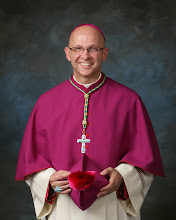
A Lenten Retreat with Fr. Berard Doerger, OFM
At Sacred heart Retreat Center on the Tuesdays of March…
The first four Tuesdays…6:00-9:00, cost $20.00 per evening
Or if you purchase 4 at the same time it is $75.00. He will
Be opening the Gospels of Mark, Matthew, Luke and John.
Mass, Dinner, Presentation…
Please call 722-6755 to make reservations.
Bread for the Journey -- Sacred Heart Retreat Center
March 5, 2009 -- 6:00-9:00 p.m.
Mass, dinner, presentation -- Cost is $20.00
Theme: On Christian Hope -- Sister Eve Marie Korzym, osf
Diocesan Director of Religious education
Monday, February 16, 2009
Friday, February 13, 2009
Bishop's Schedule of Known Events from April 22 to June 19, 2009
April 22, 2009
· 6:30 Vespers – family, bishops & priests only
· 7:15 Reception after Vespers – family, bishops & priests only
Thursday, April 23, 2009
· 11:30 am Bishops social and luncheon
· 2:00 pm Liturgy of Ordination
Friday, April 24, 2009
· 6:30 pm – Ordination banquet, Farmington.
Saturday, April 25, 2009
· 9:00 am – 10:30 am - Youth breakfast – Farmington.
· 4:30 pm – Confirmation Mass – Sacred Heart, Farmington
Sunday, April 26, 2009
· 11:00 am. Confirmation – St. Francis, Gallup – bilingual.
Tuesday, April 28, 2009
· 5:00 pm. Dinner with Friars & Sisters at St. Michaels
· 7:00 pm. Confirmation at St. Michaels
Thursday, April 30, 2009
· 4:30 pm Clergy dinner– St. Teresa
· 6:30 pm Confirmation at St. Teresa
May 2, 2009
· 5:00 pm Parish Mass – St. Anne’s Acomita
Reception and dinner in Acomita
May 3, 2009
· 8:00 am Parish Sunday Mass – Our Lady of Light, Cubero
· 5:00 pm Confirmation Mass – St. Elizabeth – Paguate Village
May 7, 2009
· 6:30 pm. Confirmation OLOGuadalupe, Holbrook.
May 9, 2009
· 11:00 am. Confirmations – St. Peters, Springerville
· 5:30 pm. Confirmation-St. Josephs , Winslow
May 10, 2009
· Parish Masses in Gallup 8am Sunday, SHC – 11:30a m Sunday St. John Vianney.
May 16, 2009
· 5:30 pm. Confirmation, Immaculate Conception, Cuba.
May 17, 2009
· 9:00 am. Sunday Mass, St. Anne’s Mission, Klagetoh
· 11:00 am. Sunday Mass, All Saints Parish, Ganado
Tuesday, May 19, 2009
· 11:00 am. Meeting with Shalom Reconciliation Group. Sacred Heart Retreat
Thursday, May 21, 2009
· 7:00 pm. Gallup, Catholic Graduation Mass.
Friday, May 22, 2009
· 6:00 pm. Baccalaureate St. Michaels High School
Saturday, May 23, 2009
· 11:00 am. Confirmation – St. Patricks, Chichiltah
Sunday, May 24, 2009
· 9:00 am Sunday Mass – Christ the King, Shiprock.
Thursday, May 28, 2009
· Confirmation St. Mary of the Angels, Pinetop
Friday, May 29, 2009
· 7:00 pm Confirmation St. Mary Church, Farmington
Saturday, May 30, 2009
· 10:00 am. Confirmation St. Mary Church, Bloomfield
Sunday, May 31, 2009 PENTECOST
11:00 am. Confirmation, Sacred Heart Cathedral.
Saturday, June 6-7, 2009
· Presbyteral ordinations in Phoenix.
Tuesday, June 9, 2009
· Arizona Catholic Conference, Tucson – 10am – 2pm.
Wednesday – Friday, June 17-19, 2009
· USCCB Spring Plenary Session – San Antonio
· 6:30 Vespers – family, bishops & priests only
· 7:15 Reception after Vespers – family, bishops & priests only
Thursday, April 23, 2009
· 11:30 am Bishops social and luncheon
· 2:00 pm Liturgy of Ordination
Friday, April 24, 2009
· 6:30 pm – Ordination banquet, Farmington.
Saturday, April 25, 2009
· 9:00 am – 10:30 am - Youth breakfast – Farmington.
· 4:30 pm – Confirmation Mass – Sacred Heart, Farmington
Sunday, April 26, 2009
· 11:00 am. Confirmation – St. Francis, Gallup – bilingual.
Tuesday, April 28, 2009
· 5:00 pm. Dinner with Friars & Sisters at St. Michaels
· 7:00 pm. Confirmation at St. Michaels
Thursday, April 30, 2009
· 4:30 pm Clergy dinner– St. Teresa
· 6:30 pm Confirmation at St. Teresa
May 2, 2009
· 5:00 pm Parish Mass – St. Anne’s Acomita
Reception and dinner in Acomita
May 3, 2009
· 8:00 am Parish Sunday Mass – Our Lady of Light, Cubero
· 5:00 pm Confirmation Mass – St. Elizabeth – Paguate Village
May 7, 2009
· 6:30 pm. Confirmation OLOGuadalupe, Holbrook.
May 9, 2009
· 11:00 am. Confirmations – St. Peters, Springerville
· 5:30 pm. Confirmation-St. Josephs , Winslow
May 10, 2009
· Parish Masses in Gallup 8am Sunday, SHC – 11:30a m Sunday St. John Vianney.
May 16, 2009
· 5:30 pm. Confirmation, Immaculate Conception, Cuba.
May 17, 2009
· 9:00 am. Sunday Mass, St. Anne’s Mission, Klagetoh
· 11:00 am. Sunday Mass, All Saints Parish, Ganado
Tuesday, May 19, 2009
· 11:00 am. Meeting with Shalom Reconciliation Group. Sacred Heart Retreat
Thursday, May 21, 2009
· 7:00 pm. Gallup, Catholic Graduation Mass.
Friday, May 22, 2009
· 6:00 pm. Baccalaureate St. Michaels High School
Saturday, May 23, 2009
· 11:00 am. Confirmation – St. Patricks, Chichiltah
Sunday, May 24, 2009
· 9:00 am Sunday Mass – Christ the King, Shiprock.
Thursday, May 28, 2009
· Confirmation St. Mary of the Angels, Pinetop
Friday, May 29, 2009
· 7:00 pm Confirmation St. Mary Church, Farmington
Saturday, May 30, 2009
· 10:00 am. Confirmation St. Mary Church, Bloomfield
Sunday, May 31, 2009 PENTECOST
11:00 am. Confirmation, Sacred Heart Cathedral.
Saturday, June 6-7, 2009
· Presbyteral ordinations in Phoenix.
Tuesday, June 9, 2009
· Arizona Catholic Conference, Tucson – 10am – 2pm.
Wednesday – Friday, June 17-19, 2009
· USCCB Spring Plenary Session – San Antonio
Death Notice
+Macario Campos the father of Deacon Jorge Campos died last night at a hospital in Silver City, New Mexico.
A rosary will be recited at 6:00 pm on Sunday, February 15th and a funeral Mass celebrated on Monday, February 16th at St. Joseph Church in Lordsburg, New Mexico.
Please pray for the soul of +Macario Campos and for the Deacon Jorge Campos family.
Tuesday, February 10, 2009
Message of His Holiness Pope Benedict XVI for 18th World Day of the Sick. February 11, 2009
Dear Brothers and Sisters,
The World Day of the Sick, which will be celebrated on 11 February
of this year, the liturgical memorial of the Blessed Virgin Mary of Lourdes,
will see the diocesan communities meet with their bishops in moments of
prayer, in order to reflect and to decide upon initiatives of sensitisation
connected with the reality of suffering. The Pauline Year that we are
celebrating offers a propitious opportunity to stop and reflect with the
apostle Paul on the fact that “just as the sufferings of Christ overflow into
our lives; so too does the encouragement we receive through Christ” (2 Cor
1:5). The spiritual link with Lourdes, in addition, calls to mind the maternal
solicitude of the Mother of Jesus for the brethren of her Son “who still
journey on earth surrounded by dangers and difficulties, until they are led
into the happiness of their true home” (Lumen gentium, n. 62).
This year we direct our attention particularly to children, the weakest
and most defenceless creatures, and, amongst them, to the sick and
suffering children. There are little human beings who carry in their bodies
the consequences of illnesses which have made them invalids and others
who fight against diseases that are now incurable despite the progress of
medicine and the care of qualified researchers and health-care
professionals. There are children wounded in their bodies and souls as a
consequence of conflicts and wars, and other innocent victims of the hatred
of senseless adults. There are ‘street’ children, deprived of the warmth of a
family and abandoned to themselves, and minors profaned by abject people
who violate their innocence, provoking in them a psychological wound that
will mark them for the rest of their lives. And we cannot forget the
incalculable number of young people who die because of thirst, hunger,
lack of health care, and the little exiles and refugees from their own lands,
with their parents, who are in search of better conditions of life. From all
these children arises a silent cry of pain that calls on our conscience as men
and believers.
The Christian community, which cannot remain indifferent to such
dramatic situations, perceives the impelling duty to intervene. The Church,
indeed, as I wrote in the encyclical Deus caritas est, “is God’s family in
the world. In this family no one ought to go without the necessities of life”
(n. 25, b). I thus hope that the World Day of the Sick will also offer an
opportunity to parish and diocesan communities to become increasingly
aware that they are “God’s family”, and will encourage them to make the
love of the Lord, who asks that “within the ecclesial family no member
should suffer through being in need” (ibid.), perceivable in villages,
neighbourhoods and cities. Witness to charity is a part of the life itself of
every Christian community. And from the outset the Church translated
Gospel principles into concrete actions, as we can read in the Acts of the
Apostles. Today, given the changed conditions of health care, the need is
perceived for closer cooperation between health-care workers who work in
various health-care institutions and the ecclesial communities present in
local areas. From this perspective, all the value is demonstrated of an
institution that is connected with the Holy See, the “Bambino Gesù”
Children’s Hospital, which this year celebrates its 140 years of existence.
But there is more. Since a sick child belongs to a family that shares
his or her suffering often with great hardship and difficulties, Christian
communities cannot but also make themselves responsible for helping
family units that are afflicted by the illness of a son or daughter. Following
the example of the “Good Samaritan”, one should bend down in front of
people who are so sorely troubled and offer them the support of practical
solidarity. In this way, the acceptance and sharing of suffering is translated
into a useful support to the families of sick children, creating within them a
climate of serenity and hope, and making them feel surrounded by a wider
family of brothers and sisters in Christ. The compassion of Jesus for the
weeping of the widow of Nain (cf. Lk 7:12-17) and for the imploring
prayer of Jairus (cf. Lk 8:41-56) constitute, amongst others, certain useful
points of reference by which to learn to share in the moments of physical
and moral tribulation of so many afflicted families. All of this presupposes
a disinterested and generous love, a reflection and sign of the merciful love
of God who never abandons his children in affliction, but always provides
them with admirable resources of the heart and intelligence, so that they
can adequately address the difficulties of life.
The daily dedication and tireless commitment to the service of sick
children constitute an eloquent testimony of love for human life, in
particular for the life of those who are weak and who are in everything and
for everything dependent on others. It is, indeed, necessary to affirm with
vigour the absolute and supreme dignity of every human life. The teaching
that the Church proclaims incessantly does not change with the passing of
time: human life is beautiful and should be lived in fullness even when it is
weak and shrouded by the mystery of suffering. It is to Jesus that we must
direct our gaze: in dying on the cross he wanted to share the pain of all
humanity. In his suffering for love we see a supreme co-participation in the
sufferings of sick children and their parents. My venerable predecessor
John Paul II, who offered a shining example of the patient acceptance of
suffering, especially at the sunset of his life, wrote: “on this Cross is the
‘Redeemer of man’, the Man of Sorrows, who has taken upon himself the
physical and moral sufferings of the people of all times, so that in love they
may find the salvific meaning of their sorrow and valid answers to all of
their questions” (Salvifici doloris, n. 31) .
I wish here to express my appreciation and encouragement of the
international and national organisations that provide care to sick children,
especially in poor countries, and with generosity and self-denial offer their
contribution to assure that such children have adequate and loving care. At
the same time I address a sorrowful appeal to the leaders of nations to
strengthen laws and measures in favour of sick children and their families.
Always, but even more when the lives of children are at stake, the Church,
for her part, makes herself ready to offer her cordial cooperation, with the
intention of transforming the whole of human civilisation into a
“civilisation of love” (cf. Salvifici doloris, n. 30).
To end, I would like to express my spiritual nearness to all of you,
dear brothers and sisters, who suffer from an illness. I address an
affectionate greeting to those who help you: to bishops, to priests, to
consecrated men and women, to health-care workers, to volunteers and to
all those who dedicate themselves with love to treating and alleviating the
sufferings of those who have to face up to illness. A special greeting for
you, dear sick and suffering children: the Pope embraces you with fatherly
love, together with your parents and relatives; he assures you that you are
especially remembered in his prayers, inviting you to trust in the maternal
help of the Immaculate Virgin Mary, who last Christmas we once again
contemplated while she held in her arms the Son of God made child.
Invoking upon you and every sick person the protection of the Holy Virgin,
Health of the Sick, to all of you from my heart I impart a special Apostolic
Blessing.
From the Vatican, 2 February 2009
Benedictus P.P. XVI
The World Day of the Sick, which will be celebrated on 11 February
of this year, the liturgical memorial of the Blessed Virgin Mary of Lourdes,
will see the diocesan communities meet with their bishops in moments of
prayer, in order to reflect and to decide upon initiatives of sensitisation
connected with the reality of suffering. The Pauline Year that we are
celebrating offers a propitious opportunity to stop and reflect with the
apostle Paul on the fact that “just as the sufferings of Christ overflow into
our lives; so too does the encouragement we receive through Christ” (2 Cor
1:5). The spiritual link with Lourdes, in addition, calls to mind the maternal
solicitude of the Mother of Jesus for the brethren of her Son “who still
journey on earth surrounded by dangers and difficulties, until they are led
into the happiness of their true home” (Lumen gentium, n. 62).
This year we direct our attention particularly to children, the weakest
and most defenceless creatures, and, amongst them, to the sick and
suffering children. There are little human beings who carry in their bodies
the consequences of illnesses which have made them invalids and others
who fight against diseases that are now incurable despite the progress of
medicine and the care of qualified researchers and health-care
professionals. There are children wounded in their bodies and souls as a
consequence of conflicts and wars, and other innocent victims of the hatred
of senseless adults. There are ‘street’ children, deprived of the warmth of a
family and abandoned to themselves, and minors profaned by abject people
who violate their innocence, provoking in them a psychological wound that
will mark them for the rest of their lives. And we cannot forget the
incalculable number of young people who die because of thirst, hunger,
lack of health care, and the little exiles and refugees from their own lands,
with their parents, who are in search of better conditions of life. From all
these children arises a silent cry of pain that calls on our conscience as men
and believers.
The Christian community, which cannot remain indifferent to such
dramatic situations, perceives the impelling duty to intervene. The Church,
indeed, as I wrote in the encyclical Deus caritas est, “is God’s family in
the world. In this family no one ought to go without the necessities of life”
(n. 25, b). I thus hope that the World Day of the Sick will also offer an
opportunity to parish and diocesan communities to become increasingly
aware that they are “God’s family”, and will encourage them to make the
love of the Lord, who asks that “within the ecclesial family no member
should suffer through being in need” (ibid.), perceivable in villages,
neighbourhoods and cities. Witness to charity is a part of the life itself of
every Christian community. And from the outset the Church translated
Gospel principles into concrete actions, as we can read in the Acts of the
Apostles. Today, given the changed conditions of health care, the need is
perceived for closer cooperation between health-care workers who work in
various health-care institutions and the ecclesial communities present in
local areas. From this perspective, all the value is demonstrated of an
institution that is connected with the Holy See, the “Bambino Gesù”
Children’s Hospital, which this year celebrates its 140 years of existence.
But there is more. Since a sick child belongs to a family that shares
his or her suffering often with great hardship and difficulties, Christian
communities cannot but also make themselves responsible for helping
family units that are afflicted by the illness of a son or daughter. Following
the example of the “Good Samaritan”, one should bend down in front of
people who are so sorely troubled and offer them the support of practical
solidarity. In this way, the acceptance and sharing of suffering is translated
into a useful support to the families of sick children, creating within them a
climate of serenity and hope, and making them feel surrounded by a wider
family of brothers and sisters in Christ. The compassion of Jesus for the
weeping of the widow of Nain (cf. Lk 7:12-17) and for the imploring
prayer of Jairus (cf. Lk 8:41-56) constitute, amongst others, certain useful
points of reference by which to learn to share in the moments of physical
and moral tribulation of so many afflicted families. All of this presupposes
a disinterested and generous love, a reflection and sign of the merciful love
of God who never abandons his children in affliction, but always provides
them with admirable resources of the heart and intelligence, so that they
can adequately address the difficulties of life.
The daily dedication and tireless commitment to the service of sick
children constitute an eloquent testimony of love for human life, in
particular for the life of those who are weak and who are in everything and
for everything dependent on others. It is, indeed, necessary to affirm with
vigour the absolute and supreme dignity of every human life. The teaching
that the Church proclaims incessantly does not change with the passing of
time: human life is beautiful and should be lived in fullness even when it is
weak and shrouded by the mystery of suffering. It is to Jesus that we must
direct our gaze: in dying on the cross he wanted to share the pain of all
humanity. In his suffering for love we see a supreme co-participation in the
sufferings of sick children and their parents. My venerable predecessor
John Paul II, who offered a shining example of the patient acceptance of
suffering, especially at the sunset of his life, wrote: “on this Cross is the
‘Redeemer of man’, the Man of Sorrows, who has taken upon himself the
physical and moral sufferings of the people of all times, so that in love they
may find the salvific meaning of their sorrow and valid answers to all of
their questions” (Salvifici doloris, n. 31) .
I wish here to express my appreciation and encouragement of the
international and national organisations that provide care to sick children,
especially in poor countries, and with generosity and self-denial offer their
contribution to assure that such children have adequate and loving care. At
the same time I address a sorrowful appeal to the leaders of nations to
strengthen laws and measures in favour of sick children and their families.
Always, but even more when the lives of children are at stake, the Church,
for her part, makes herself ready to offer her cordial cooperation, with the
intention of transforming the whole of human civilisation into a
“civilisation of love” (cf. Salvifici doloris, n. 30).
To end, I would like to express my spiritual nearness to all of you,
dear brothers and sisters, who suffer from an illness. I address an
affectionate greeting to those who help you: to bishops, to priests, to
consecrated men and women, to health-care workers, to volunteers and to
all those who dedicate themselves with love to treating and alleviating the
sufferings of those who have to face up to illness. A special greeting for
you, dear sick and suffering children: the Pope embraces you with fatherly
love, together with your parents and relatives; he assures you that you are
especially remembered in his prayers, inviting you to trust in the maternal
help of the Immaculate Virgin Mary, who last Christmas we once again
contemplated while she held in her arms the Son of God made child.
Invoking upon you and every sick person the protection of the Holy Virgin,
Health of the Sick, to all of you from my heart I impart a special Apostolic
Blessing.
From the Vatican, 2 February 2009
Benedictus P.P. XVI
Saturday, February 7, 2009
Prayer Request
Deacon Jorge Campos requests prayers for his father, Macario Campos, who is critically ill in the hospital in Silver City, NM.
Friday, February 6, 2009
Ordination/Installation date of Bishop-elect Wall is set
The Episcopal Ordination and Installation as the Fourth Bishop of the Diocese of Gallup of
Bishop-elect James S. Wall is scheduled for Thursday, April 23rd at 2:00 in the afternoon at
Sacred Heart Cathedral in Gallup.
Bishop-elect James S. Wall is scheduled for Thursday, April 23rd at 2:00 in the afternoon at
Sacred Heart Cathedral in Gallup.
Thursday, February 5, 2009
¡Tenemos un obispo! - We have a bishop!

POPE NAMES PHOENIX PRIEST AS BISHOP OF GALLUP, NEW MEXICO
WASHINGTON—Pope Benedict XVI named Father James S. Wall, 44, Vicar for Clergy of the Diocese of Phoenix, as Bishop of Gallup, New Mexico.
The appointment was announced in Washington, February 5, by Archbishop Pietro Sambi, apostolic nuncio to the United States.
Bishop-elect Wall succeeds Bishop Donald E. Pelotte, SSS, who resigned as head of the Gallup Diocese last April.
James Wall, son of Joan L. Wall and the late James A. Wall, was born in Ganado, Arizona, October 11, 1964. The couple and their children together converted to the Catholic faith.
Bishop-elect Wall graduated from Chandler High School and Arizona State University with a Bachelor of Arts degree in history in 1993. He obtained a Master of Divinity degree in theology from St. John’s Seminary, Camarillo, California, in 1998.
He was ordained to the priesthood for the Phoenix Diocese on June 6, 1998.
Assignments after ordination included Parochial Vicar, St. Theresa Parish, Phoenix, 1998-2001; Parochial Vicar, St. Timothy Parish, Mesa, Arizona, 2001-2002; Pastor, St. Thomas the Apostle Parish, Phoenix, 2002-2007; Administrator pro tempore, Our Lady of Perpetual Help Parish, Glendale, Arizona, 2007; Vicar for Priest Personnel, 2007-2009; and Director, Mount Claret Retreat Center, Phoenix, 2008-2009.
The Gallup Diocese includes 55,468 square miles and a population of 491,400 people, with 58,292 or 12 per cent, of them Catholic.
WASHINGTON—Pope Benedict XVI named Father James S. Wall, 44, Vicar for Clergy of the Diocese of Phoenix, as Bishop of Gallup, New Mexico.
The appointment was announced in Washington, February 5, by Archbishop Pietro Sambi, apostolic nuncio to the United States.
Bishop-elect Wall succeeds Bishop Donald E. Pelotte, SSS, who resigned as head of the Gallup Diocese last April.
James Wall, son of Joan L. Wall and the late James A. Wall, was born in Ganado, Arizona, October 11, 1964. The couple and their children together converted to the Catholic faith.
Bishop-elect Wall graduated from Chandler High School and Arizona State University with a Bachelor of Arts degree in history in 1993. He obtained a Master of Divinity degree in theology from St. John’s Seminary, Camarillo, California, in 1998.
He was ordained to the priesthood for the Phoenix Diocese on June 6, 1998.
Assignments after ordination included Parochial Vicar, St. Theresa Parish, Phoenix, 1998-2001; Parochial Vicar, St. Timothy Parish, Mesa, Arizona, 2001-2002; Pastor, St. Thomas the Apostle Parish, Phoenix, 2002-2007; Administrator pro tempore, Our Lady of Perpetual Help Parish, Glendale, Arizona, 2007; Vicar for Priest Personnel, 2007-2009; and Director, Mount Claret Retreat Center, Phoenix, 2008-2009.
The Gallup Diocese includes 55,468 square miles and a population of 491,400 people, with 58,292 or 12 per cent, of them Catholic.
Subscribe to:
Posts (Atom)